
If you’ve ever used a weather app, booked a cab, logged into a website, or made an online payment, you’ve already benefited from APIs—even if you didn’t know they existed.
APIs are one of the most important building blocks of modern software, enabling applications to communicate and exchange information with each other.
In this guide, we’ll understand what an API is, why it’s needed, and how it works through a simple real-world example.
What Is an API?
API stands for Application Programming Interface.
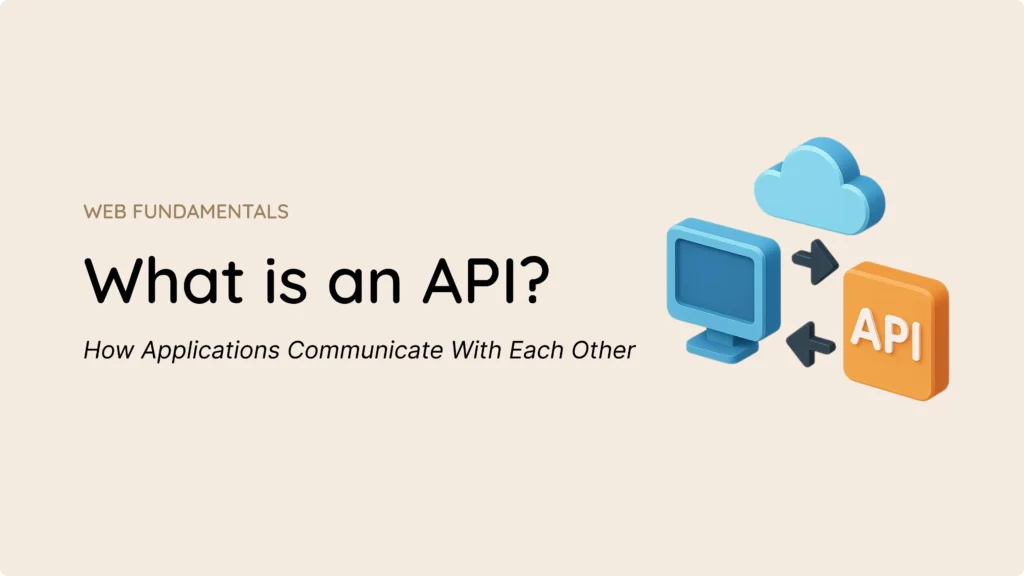
In simple terms, an API is a bridge that allows different applications or services to communicate with each other.
Instead of building everything from scratch, applications can request information or functionality from another service using an API.
Think of an API as a waiter in a restaurant.
- You place an order.
- The waiter takes your request to the kitchen.
- The kitchen prepares the food.
- The waiter brings it back to you.
You don’t need to know how the kitchen works—you simply receive the result.
An API works in a very similar way.
Why Do We Need APIs?
Applications can’t do everything on their own.
For example:
- A weather app doesn’t generate weather data.
- A maps application doesn’t create satellite imagery.
- A payment app doesn’t directly manage your bank account.
Instead, they request information or services from specialized systems.
Without APIs, every application would need to build and maintain every feature itself, which would be inefficient and impractical.
How Does an API Work?
The communication process is surprisingly simple.
- Your application sends a request.
- The API receives that request.
- The API forwards it to the appropriate server or service.
- The server processes the request.
- The API returns the response to your application.
This entire process usually happens in a fraction of a second.
A Real-World Example
Imagine you open a weather app and search for the weather in Lucknow.
Here’s what happens behind the scenes:
- You search for Lucknow.
- The weather app sends a request to a Weather API.
- The Weather API asks a weather service for the latest forecast.
- The weather service responds with data such as:
- Temperature
- Humidity
- Wind Speed
- Weather Condition
- The API sends that information back to the weather app.
- The app displays it on your screen.
The app never creates the weather information itself—it simply requests it through an API.
Where Are APIs Used?
APIs power countless digital experiences we use every day, including:
- Weather applications
- Google Maps and navigation
- Online payments
- Social media logins
- Food delivery apps
- E-commerce websites
- Streaming platforms
- AI applications like ChatGPT
Whenever one application needs information or functionality from another system, there’s a good chance an API is involved.
Why Are APIs Important?
APIs offer several advantages:
- Reuse existing services instead of rebuilding them.
- Enable communication between different systems.
- Save development time.
- Simplify application integration.
- Improve scalability and maintainability.
Without APIs, today’s interconnected digital world wouldn’t function the way it does.
Quick Recap
Here’s the entire process in one simple flow:
Application → API → Server
Server → API → Application
In short:
- The application sends a request.
- The API acts as the communication bridge.
- The server processes the request.
- The API returns the response.
Final Thoughts
APIs are everywhere.
Although users rarely see them, they quietly power many of the features we rely on every day—from checking the weather to making online payments.
Understanding APIs is one of the first major steps toward understanding how modern web applications work.
If you’re beginning your web development journey, this concept will make learning topics like REST APIs, HTTP methods, JSON, and authentication much easier.